Reading time: 13 min
The AI agent development process is not a single decision point. It is a structured engineering lifecycle, and in regulated environments it is the only thing standing between a working demo and an agent nobody will sign off on.
- 6
- Lifecycle stages, none of them optional
- 3
- Architecture patterns to choose between upfront
- 2
- Levels of agent hierarchy before complexity spikes
- 0
- Compliance requirements you can retrofit cheaply
Most teams entering the AI agent development process assume the hard part is picking a model. It rarely is. The hard part is treating this as engineering discipline rather than an extended prompt experiment, and skipping a phase usually means rebuilding after a failed release.
What follows is the lifecycle ITDS Portugal runs across finance, healthcare and retail, where compliance and performance are constraints rather than preferences. If you are building a first MVP rather than an enterprise deployment, our guide for startups going from MVP to launch is the better starting point.
Discovery sets up the whole AI agent development process
This is the highest-leverage phase and the one most often skipped. Define what the agent must accomplish, who the stakeholders are, and what success looks like in measurable terms: task completion rate, latency targets, cost per run. Teams that treat discovery as optional rebuild after deployment, because the architecture they picked does not fit the problem they actually had.
| Pattern | Suits | Watch for |
|---|---|---|
| Reactive | Narrow single-task automation with deterministic logic | Outgrown quickly if the task is not genuinely narrow |
| Cognitive or reasoning | Complex decision pipelines needing multi-step reasoning | Hardest to tune and govern correctly |
| Multi-agent | Networks of specialists coordinating toward one goal | Complexity rises sharply past two levels of depth |
Swipe the table sideways to see all columns.
Getting this wrong is not a minor inconvenience. It forces a full redesign once the limits surface under real workloads.
Treat GDPR, HIPAA and the applicable data protection frameworks as design inputs. Data classification, access controls, audit hooks and encryption requirements get wired in before development starts. In healthcare, an agent touching protected health information generally needs Business Associate Agreements with vendors, de-identification protocols for training data, and human oversight on clinical decisions. None of that retrofits neatly.
Instructions and orchestration
In the AI agent development process, framework selection follows architecture requirements rather than the other way round. Open-source options give you control at the cost of operational overhead, vendor platforms abstract that complexity at the cost of flexibility. That trade is the decision, not the brand names.
Agent instruction design is where projects fail quietly. A well-structured instruction set has four parts.
Persona
The agent's role and tone, defined rather than implied.Goal statement
A clear expected outcome the agent can be measured against.Process guidelines
The specific business logic and decision criteria the agent applies.Constraints
What the agent must not do, stated explicitly rather than assumed.
A leading cause of failure is vague instructions combined with overlapping tool definitions. Keep the two separate: tool descriptions state technical facts about what a tool does and returns, agent instructions describe when and why to use it. Conflate them and the agent picks badly under ambiguity, which is exactly when you need it to pick well.
On orchestration, keep individual tasks focused on single objectives and use a main orchestrator to coordinate specialised sub-agents rather than chaining agents into long fragile sequences. Limit collaboration to two levels of depth, because deeper hierarchies push errors and operational complexity up non-linearly.
Longer workflows also reduce accuracy, so minimising steps is a performance requirement rather than an efficiency preference. Version control, sandboxing and gateway patterns belong in the build phase, not a later hardening sprint.
Evaluation is where the AI agent development process gets rigorous
The goal is not a model that performs well on generic benchmarks. It is one that performs consistently on your production inputs. For document-driven agents, RAG toolchains carry much of the knowledge retrieval load, and in regulated industries domain data quality maps directly onto reliability.
Pick metrics deliberately, mixing component-level indicators with at least one end-to-end completion measure.
- Task success rate and response accuracy, measured against your own inputs rather than public benchmarks.
- Latency at typical and worst-case percentiles, because the worst case is what users remember.
- Cost per run and token usage, tracked from the first evaluation rather than the first invoice.
- Consistency scores and policy adherence rate, the second of which becomes a continuous production metric later.
For multi-step agents, trajectory evaluation is the most rigorous method available. It measures exact match, where the action sequence mirrors the ideal, in-order match, where all necessary actions occur in the right order, and precision or recall of essential actions. The value is diagnostic: it tells you roughly where in the reasoning chain the failure happened, which beats knowing only that the final answer was wrong.
Pre-production safety validation is non-negotiable for any agent touching sensitive data or making consequential decisions. Prompt injection testing, PII scanning, hallucination detection, bias scoring. Curated golden datasets containing defined inputs, expected outputs and expected tool call trajectories are the benchmark, and human review calibrates the automated judges before certification.
Deployment and progressive rollout
At the deployment stage of the AI agent development process, compute choice comes down to two variables: how stateful the agent is and how its traffic behaves.
| Option | Fits |
|---|---|
| Serverless (Lambda, Cloud Run) | Stateless agents with sporadic or unpredictable traffic, idle cost stays low |
| Containers (ECS, Kubernetes) | Stateful agents needing consistent environments and low latency |
| Dedicated VMs | High volume where cold start latency is unacceptable |
Whatever you pick, externalise state to key-value stores or vector databases. Session affinity creates hotspots that break failover and block horizontal scaling.
Shadow mode
Run the agent against real traffic without affecting outputs. Behaviour problems surface before any user sees them.Canary release
Expose a small percentage of traffic to the new version while the majority stays on the stable one.Full rollout
Only after canary metrics confirm acceptable behaviour, never on a calendar date.
Runtime governance needs sandboxing, versioning, rollback strategies and circuit breakers at the orchestration layer to isolate a misbehaving agent. Where agents execute untrusted code, MicroVM isolation gives hardware-enforced boundaries that namespace separation cannot match.
On cost, track spend per agent from the start. It tells you whether quality gains justify runtime cost and makes scaling decisions evidence-based. Be realistic on timelines too: building on a major cloud provider commonly takes a small dedicated team several months before one agent is production-ready.
Monitoring, drift and auditability
The AI agent development process does not end at release, and standard application monitoring misses what matters after it. It captures request latency and error rates but not tool call traces, model call retries, handoff failures or finish reasons. Distributed tracing is the observability foundation, capturing the chain from prompt through tool execution through output. Without it, debugging a production agent becomes guesswork with a dashboard attached.
Agents also degrade silently without active drift detection. The outer improvement loop means detecting model drift, analysing failure trajectories, updating prompts and tool definitions against repeated mistake patterns, and retraining on new production data. This is an ongoing operational responsibility rather than a quarterly maintenance task. Agents are living systems sitting between changing external data, evolving user behaviour and upstream model updates you do not control.
Finance and healthcare need decision-level auditability, not system logs. Track policy adherence continuously rather than measuring it once at certification. Governance hooks, meaning access logs, response filtering and data masking, have to survive software updates without manual reconfiguration after every release. Under HIPAA that means a full audit trail of every agent decision touching protected health information, with the human oversight steps documented in the workflow itself.
How ITDS Portugal structures delivery
We run the lifecycle with compliance checkpoints embedded from the start: planning, architecture, build and pipeline coordination, training and testing, deployment, then monitoring and continuous optimisation. The principle underneath it is simple. Compliance requirements in finance, healthcare and retail are not obstacles to delivery velocity. Integrated early, they prevent the rework that happens when they arrive late.
Project teams combine AI engineers, data specialists and DevOps practitioners drawn from a candidate database built over years of specialised IT recruitment. That matters most on multi-agent systems, where the integration points between components are usually where projects run into trouble.
On engagement model, time and materials suits exploratory builds where requirements will move as the team learns the domain. Fixed-price suits well-scoped projects with defined acceptance criteria. More context in our piece on the future of artificial intelligence in IT outsourcing, and on staffing in how AI recruitment in Portugal supports rapid staffing.
Frequently Asked Questions
What is the biggest mistake teams make when building their first AI agent?
How long does it typically take to get a production-ready AI agent live?
What is the difference between component-level metrics and trajectory evaluation?
Do compliance requirements need to be addressed before or after the agent is built?
How is deploying an AI agent different from deploying regular software?
What the full AI agent development process requires
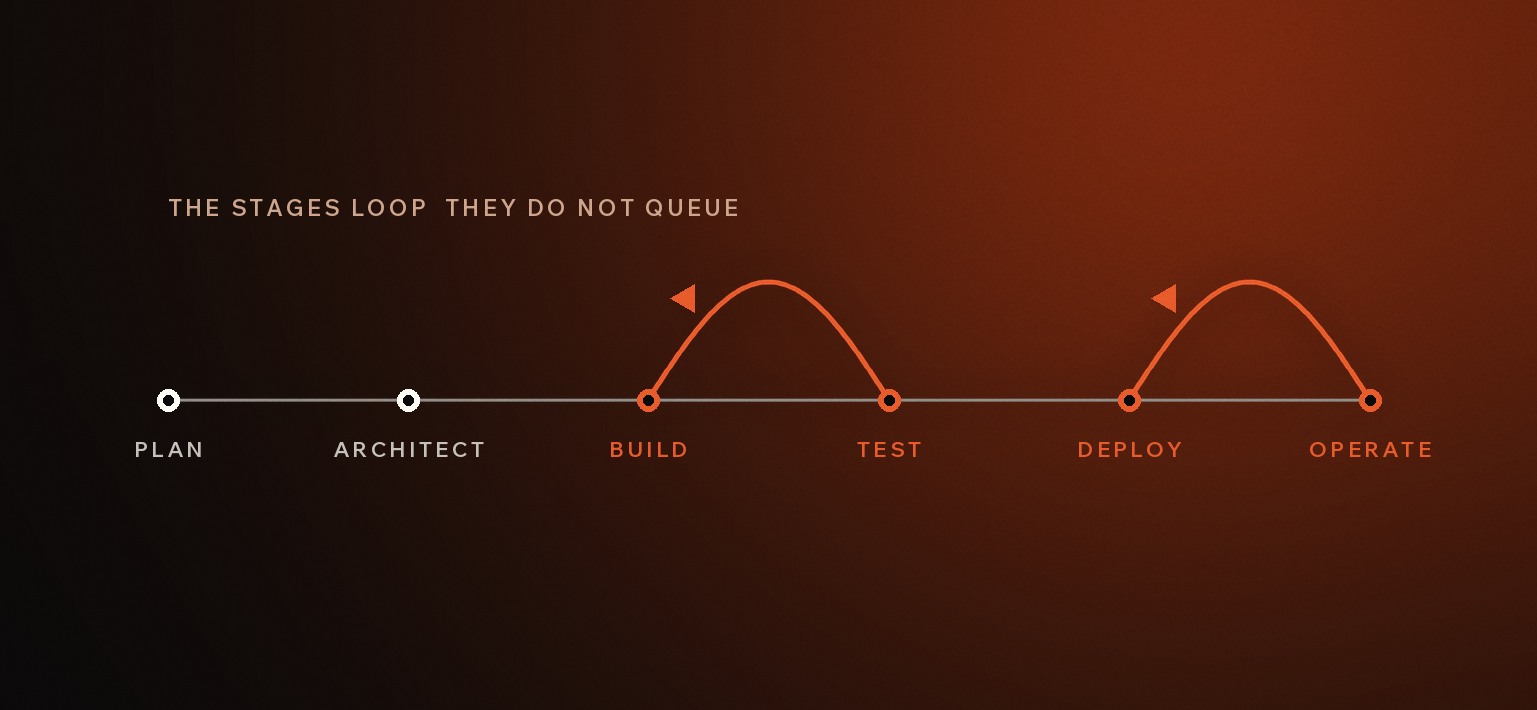
Planning, architecture selection, build and workflow coordination, training and testing, deployment with progressive rollout, monitoring with active drift detection. The stages are iterative rather than linear: teams loop between build and test repeatedly before deployment, and between deploy and operate continuously afterwards.
A reliable AI agent development process comes down to discipline more than model sophistication. In regulated industries the teams that deliver consistently are the ones that respect every phase and know how to move through it without improvising the compliance work at the end.
Planning an agent project in a regulated environment?
Book a call and we'll help you scope and sequence it, from discovery through to production.
Get in touch