Reading time: 10 min
The offshore vs nearshore outsourcing decision gets made on a rate card and paid for in delivery speed. Founders compare hourly numbers, pick the lowest, and discover months later that the real cost sat in the hours nobody was awake at the same time.
- $15-50
- Hourly, offshore in South and Southeast Asia
- $30-70
- Hourly, nearshore in Eastern Europe or LatAm
- 1-2 h
- Daily overlap offshore leaves you with
- 4
- Hidden costs that erase the rate advantage
This offshore vs nearshore outsourcing comparison covers the three delivery geographies on the dimensions that decide outcomes: rate, overlap, security exposure and the costs nobody budgets for. If you are still choosing between engagement structures rather than locations, our comparison of outsourcing models by startup stage covers that decision first.
Offshore vs nearshore outsourcing: what actually differs
Offshore means vendors in South or Southeast Asia. Nearshore means Latin America or Eastern Europe. Onshore means paying US rates for full overlap. The gap between them is not only price.
| Offshore | Nearshore | Onshore | |
|---|---|---|---|
| Hourly rate | $15 to $50 | $30 to $70 | Substantially higher |
| Monthly, senior | $3,500 to $5,500 | $4,000 to $7,000 | $12,000 to $25,000 and up |
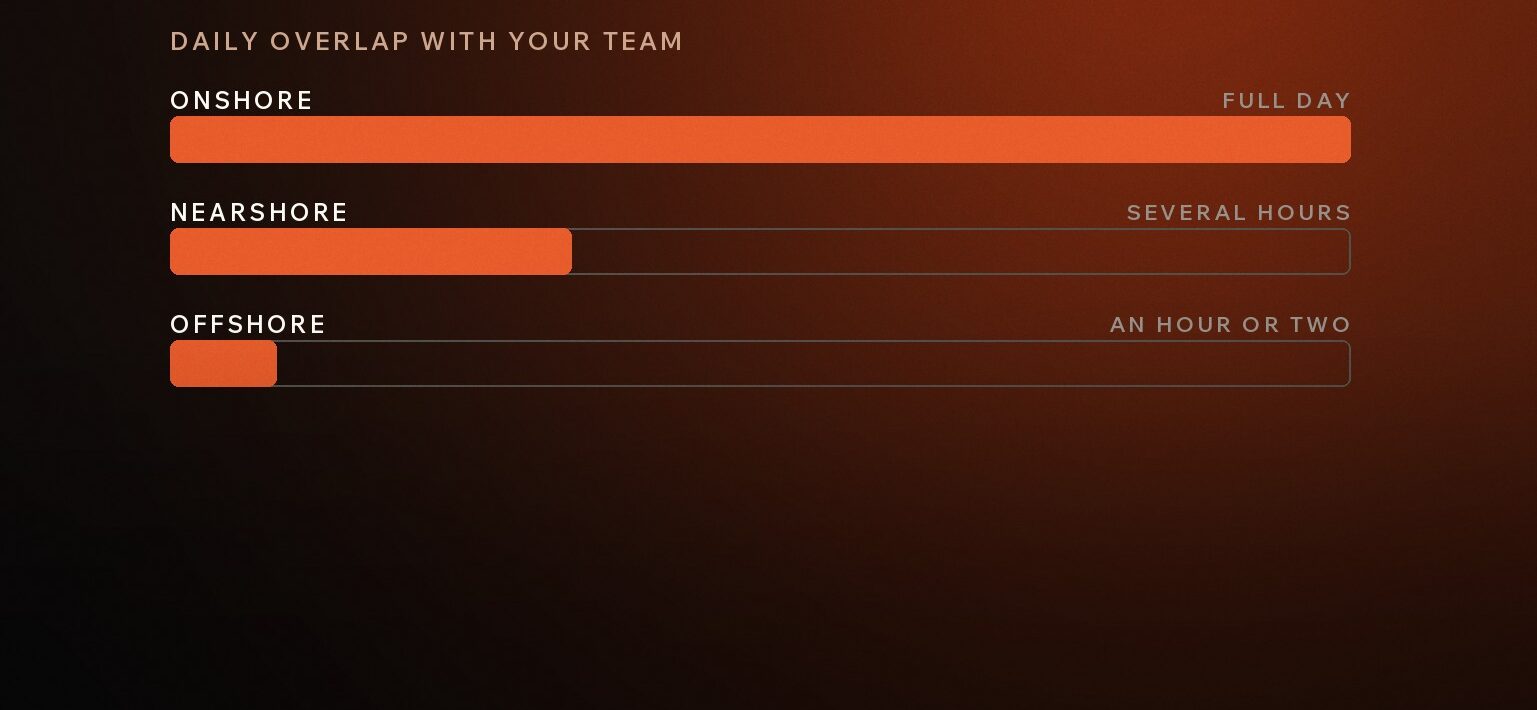
| Daily overlap with US | An hour or two | Several hours | Full |
| Blocker resolution | Next day, usually | Same day | Same hour |
| Fits | Locked scope, low iteration | Iteration-heavy product work | Regulated or highly sensitive builds |
Swipe the table sideways to see all columns.
That is the part rate cards cannot show. For teams relying on real-time collaboration, daily standups and mid-sprint course correction, the overlap window is a delivery variable rather than a convenience. It matters least when scope is locked and most when the product is still moving.
Offshore vs nearshore outsourcing costs by region
Directional totals for a comparable scope. Ranges assume a several-hundred-hour engagement across four to six months, which is the typical MVP shape. Confirm against current vendor quotes.
| Region | Simple MVP total |
|---|---|
| Offshore | $9,000 to $20,000 |
| Nearshore | $18,000 to $35,000 |
| Onshore | $60,000 to $120,000 |
Complex platforms involving AI, ML or fintech compliance multiply all three significantly, and specialised AI talent commands a premium in every region rather than only the expensive ones. Framed monthly, the offshore-to-onshore difference is not a discount. It is several times your burn rate per engineer, which is why it shapes almost every other decision here.
The four hidden costs that distort the comparison
Vendor management time
Yours, not theirs. It appears on no invoice and comes out of the same hours you would have spent building.Rework from imprecise specs
The cost of a misunderstanding scales with distance. A vague ticket resolved in a hallway conversation onshore becomes a sprint of wrong work offshore.Timezone delay
Compresses effective working hours in a way that is invisible week to week and obvious at the delivery date.The onboarding dip
Real in every model and every region. It rarely appears in a project plan and always appears in the timeline.
Together these can materially reduce the apparent advantage of the lowest hourly rate, sometimes by more than founders expect. The cheapest rate rarely produces the cheapest outcome, which is why evaluating vendors on rate cards alone is one of the more common early-stage mistakes.
Offshore vs nearshore outsourcing: security and IP exposure
In offshore vs nearshore outsourcing, geography changes the risk profile as well as the price. Offshore vendors with weak internal protocols can expose proprietary architecture, so vet for SOC 2 compliance or equivalent practices, particularly in fintech or healthcare. Nearshore delivery inside the EU brings a shared regulatory context that removes a layer of cross-border data friction entirely.
On IP, the contract should assign full source code ownership to you, ideally on creation rather than on payment, with all source files, credentials, infrastructure definitions and documentation transferring without ambiguity. This is general information rather than legal advice, and every clause belongs in front of counsel before signing.
When to keep it in-house instead
This was never an all-or-nothing decision. Early-stage startups rarely justify full-time engineering hires while requirements shift and the product has not found its audience. Once product-market fit lands and the architecture stabilises, bringing core engineers in-house protects institutional knowledge that outsourcing tends to disperse.
Outsourcing does its best work at the edges: new features, specialised stacks, overflow capacity during a product sprint. The instinct to keep everything internal and the instinct to outsource everything both produce avoidable problems, and both are expensive in the same way, just at different times.
Governance and the red flags worth acting on
Distance raises the cost of unclear expectations, which is why governance weighs heavier in offshore vs nearshore outsourcing than in any onshore arrangement.
- Three KPIs, tracked from day one: velocity in story points per sprint, error rate in bugs per feature, on-time delivery against sprint commitments.
- Weekly standups and sprint reviews as the minimum cadence for seeing what is actually being built.
- Milestone-based payment tied to accepted deliverables rather than calendar dates, with acceptance criteria defined before work starts.
- Rework percentage as a diagnostic. When it climbs, the cause is often unclear specs on your side rather than vendor underperformance, and that is a problem you can fix this week.
A vendor who resists milestone-based contracts or cannot describe their IP assignment process clearly has probably not handled either carefully before. And a vendor who quotes a fixed price before asking detailed scope questions is not validating your requirements. They are pricing in the surprises they expect later, and you will pay for those surprises whether or not they arrive.
Frequently Asked Questions
How does offshore vs nearshore outsourcing affect delivery speed?
How much does outsourcing an MVP typically cost by region?
What hidden costs make offshore look cheaper than it is?
What security checks matter most when outsourcing offshore?
When should a startup keep development in-house instead of outsourcing?
Choosing between offshore vs nearshore outsourcing
Offshore rewards a locked scope and punishes iteration. Nearshore costs more per hour and returns it in overlap when the product is still moving. Onshore is what you pay when compliance or sensitivity makes the other two too complicated to justify. None of that shows on a rate card, which is exactly why the rate card is the wrong place to start.
For more context, see our piece on flexible working models in IT outsourcing, on the rise of the dedicated-team model in why IT engineer outsourcing is gaining so many followers, and on how remote work reshaped all of it in IT outsourcing models and the impact of remote work.
Choosing between regions right now?
Book a call and we'll look at your scope, your iteration pace and your compliance exposure, and tell you which geography actually fits.
Get in touch